Passkeys were sold to users as a way to shrink the phishing surface. Threat actors responded the way they always do: they kept the story (“set up your passkey”) and swapped the trust anchor for a hostname that sounds like the thing you already believe in. When that story rides on SMS and on a single domain that accumulates a long tail of subdomains, the pattern usually means scale, not a one-off lure.
This post ties together three artifacts I collected while working the Scattered LAPSUS$ Hunter (SLH) angle: a smishing message pointing victims at a fake “passkey setup” portal, a subdomain inventory that shows how one apex domain can impersonate many brands at once, and a Telegram recruitment post from Scattered LAPSUS$ Hunter’s Telegram presence that advertises paid helpdesk calling work. I read these as parts of the same operational picture: commodity identity abuse fronted by SSO-themed naming, with a labor market on the side that buys scripted voice calls against helpdesks.
The lure: “your passkey portal” in SMS
The smishing screenshot is blunt. The sender tells the recipient that their “passkey setup portal” lives at an hxxps:// URL under passkeysso[.]com. The handset UI flags the thread as an unknown sender and nudges the user toward reporting spam, which is correct, but it is also a reminder that carrier filtering and user prompts arrive after the message already landed.
What matters analytically is the narrative fit. Passkey rollouts are noisy; helpdesks are busy; users are primed to complete a “setup” step. A domain that puts SSO and passkey in the same registrable name is engineered to ride that confusion. I am not showing the full hostname here beyond the apex; the IOC section lists representative samples in defanged form.
![Smishing lure pointing to passkey-themed host under passkeysso[.]com](/images/slh-passkeysso-smishing.png) Smishing message referencing a fake passkey setup URL (partial hostname redacted in source image).
Smishing message referencing a fake passkey setup URL (partial hostname redacted in source image).
One apex, many faces
The subdomain view I captured is the clearest sign of automation or templated provisioning. Under passkeysso[.]com I see a long tail of hostnames: some look like brand- or sector-themed labels (including names you would associate with energy and other industries), others look like noise, tests, or in-jokes, including strings that taunt researchers. Many rows carry non-zero detection ratios in VirusTotal’s subdomain listing (and related community scoring), and the records cluster on shared anycast-style resolution patterns you expect when the front end sits behind a CDN.
I am deliberately not turning the body of the post into a name-by-name parade. The point is structural: one registrable apex, many virtual hosts, shared infrastructure, mixed serious and throwaway labels. That combination is what I expect when someone is rotating brands to find clicks, not when they are running a single bespoke phish against one employer.
![Subdomain listing for passkeysso[.]com](/images/slh-passkeysso-subdomains.png) Subdomain inventory illustrating scale and mixed naming under a single apex.
Subdomain inventory illustrating scale and mixed naming under a single apex.
As of my review (March 2026), passkeysso[.]com was already attracting malicious classifications from multiple engines on VirusTotal. Separately, the TLS certificates I saw were still within their validity window and not shown as revoked in the tooling I used, meaning there was no obvious takedown from that angle then. Status changes quickly; re-check VT and certificate transparency logs before you rely on this in an incident ticket.
The other half of the pipeline: buying voices for helpdesks
The Telegram screenshot comes from Scattered LAPSUS$ Hunter’s Telegram presence: the channel brands itself as part of a global cybercrime “backbone”, and the post recruits callers for paid helpdesk work. The operator asks for a voice message to start, promises scripts, and quotes per-call payouts tied to success. Recruits are told to contact @SLSHSupport. The same SLH handle naming appears on that recruitment surface.
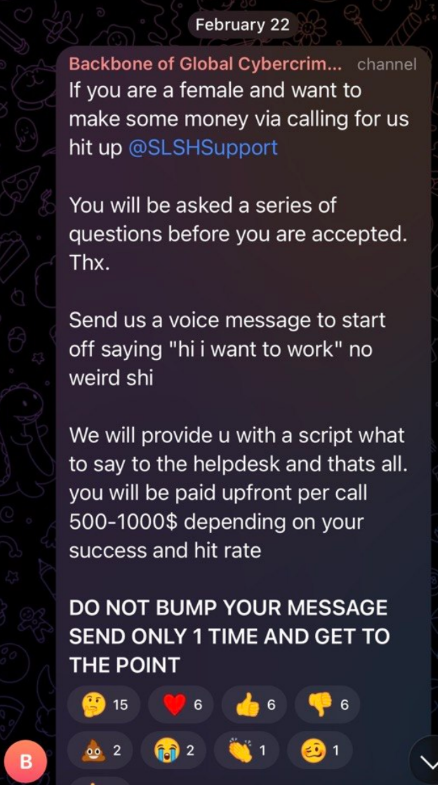 Public recruitment post: voice sample requested, scripted helpdesk calls, per-call compensation.
I treat this as strong, public evidence of vishing supply: someone is commoditizing human voice and helpdesk social engineering as a service. What the screenshot does not prove by itself is AI voice cloning. Asking for a voice note is also consistent with vetting, quality control, or later replay. I leave cloning in the open-questions bucket until there is technical evidence (artifacts, tooling, or confirmed modus operandi beyond the post).
Why SSO-themed naming hits harder than a generic phish
Enterprise identity is a chain of trust: IdP, SSO, MFA, device posture, helpdesk recovery. Threat actors only need to weaken one link. A domain that sounds like “passkey + SSO” is aimed at the mental model users already have, not at the cryptographic details they do not see.
For defenders, the actionable threads are:
- Brand and hostname monitoring for new registrations and wildcard children that track your industry peers, not only your own trademarks.
- SMS and messaging abuse reporting loops; treat passkey-themed templates as first-class in SOC playbooks.
- Helpdesk controls that resist “I just need a reset” velocity: callbacks, manager escalation, and device-bound recovery.
- Voice-in-the-loop verification: treating voice-only trust as both a policy and a tooling problem, especially when threat actors buy scripted calling labor at scale.
IOCs (defanged, representative)
Apex and a non-exhaustive sample of hostnames observed in my materials (defanged). Add your own full exports in your threat platform if you need complete coverage.
| Type |
Value |
| Apex domain |
passkeysso[.]com |
| Representative hostnames |
www[.]passkeysso[.]com, shiny[.]passkeysso[.]com, ihateshinyhunters[.]passkeysso[.]com, fakesubdomainthisisnotreal[.]passkeysso[.]com, random[.]passkeysso[.]com, ovintiv[.]passkeysso[.]com (example of brand-themed label) |
MITRE ATT&CK (Enterprise)
Mappings below are analytic labels for how I read this activity, not a claim that every sub-technique was observed end-to-end in one intrusion chain. Technique names and IDs follow MITRE ATT&CK (Enterprise).
| ID |
Technique |
Relevance here |
| T1566 |
Phishing |
Umbrella for delivery of malicious links and voice-centric lures. |
| T1566.002 |
Spearphishing Link |
SMS smishing with a URL to a fake “passkey setup” host under passkeysso[.]com. |
| T1566.004 |
Spearphishing Voice |
Recruitment and scripting for helpdesk-oriented voice work (vishing supply), as shown in the Telegram artifact. |
| T1583.001 |
Acquire Infrastructure: Domains |
Use of a registrable apex and many subdomains to stage brand-themed lures and pass traffic through shared front-end infrastructure. |
Footnote: This write-up is my read of public artifacts and tooling output I captured at the time of research. It is not legal attribution, HR or employer intelligence, or a statement on behalf of any vendor. Re-verify IOCs, certificates, and VT scores before operational use.